

Introduction
In the automotive industry, the durability of suspension springs directly impacts vehicle safety, performance, and maintenance cost. Whether it’s a leaf spring for a heavy-duty truck or a coil spring for a passenger car, each component must withstand millions of compression cycles, vibration, and environmental stress without failure.
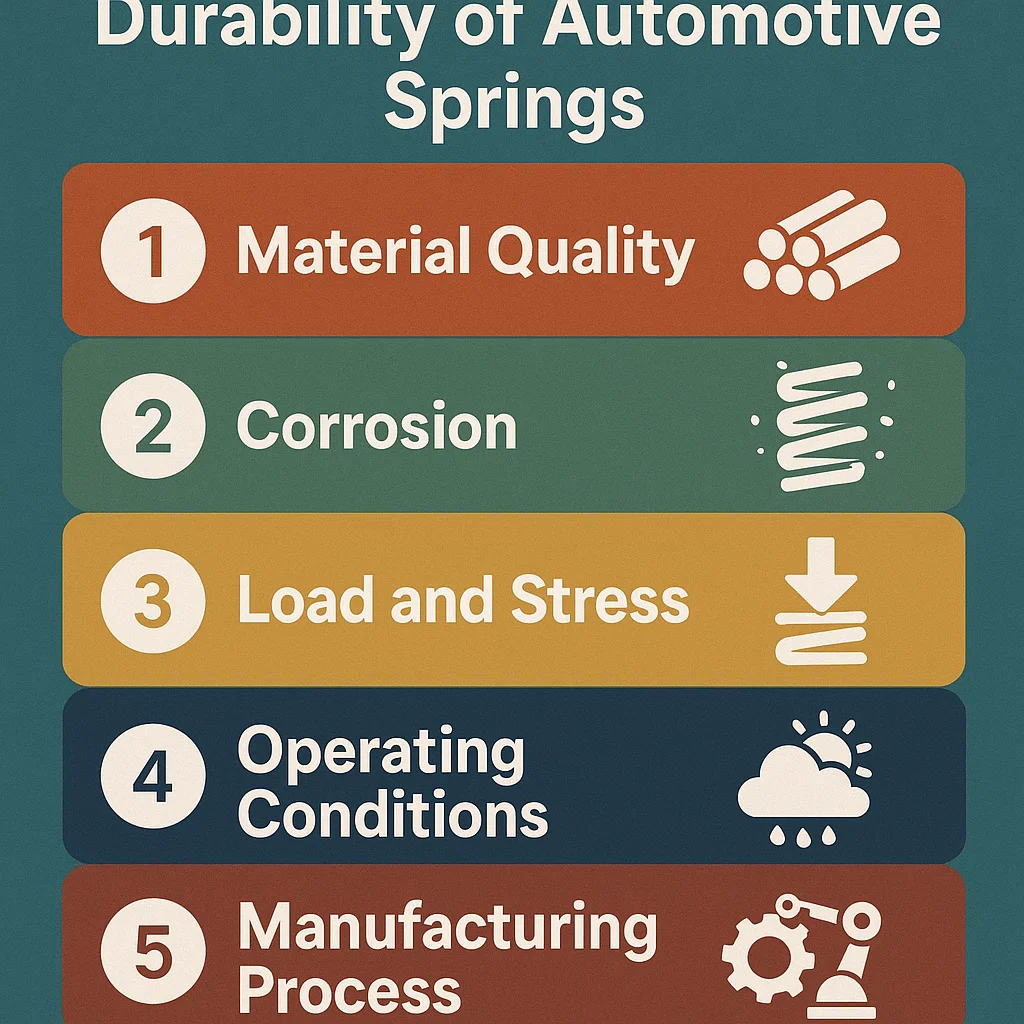
But what exactly determines how long a spring lasts? Below are the five most critical factors that influence the service life and performance of automotive springs — insights that can help you make smarter sourcing and design decisions.
1. Material Quality
The foundation of every durable spring starts with the right material.
High-grade spring steels such as 60Si2MnA, SUP9 (5160), and 50CrVA offer superior tensile strength and elasticity, allowing the spring to resist deformation under heavy loads.
Inferior materials or inconsistent steel quality can cause cracks, reduced elasticity, or premature fatigue — leading to spring failure long before the expected lifespan.
✅ Tip: Always verify the steel composition, hardness, and grain structure through material certification and testing.
2. Heat Treatment Process
Even the best steel needs precise heat treatment to perform well. Proper quenching and tempering processes significantly improve a spring’s hardness, strength, and fatigue resistance.
Incorrect temperature control or uneven heating can leave weak points in the steel, making the spring prone to breakage under cyclic stress.
At our facilities, each spring undergoes controlled heat treatment and tempering cycles to achieve optimal hardness while maintaining flexibility.
3. Surface Finishing and Protection
Springs operate in harsh conditions — exposed to water, dirt, and road salt that can cause corrosion over time. A corroded surface acts as a weak point, accelerating fatigue cracks.
That’s why surface finishing is crucial. Common treatments include:
- Shot Peening: Increases surface strength and fatigue life by inducing compressive stress.
- Painting or Powder Coating: Adds a protective barrier against rust.
- Zinc or Phosphate Coating: Provides long-term corrosion resistance.
Well-finished surfaces not only look better but also ensure the spring stays strong for years of use.
4. Design and Load Distribution
Spring geometry — including the number of leaves or coils, diameter, pitch, and spring rate — determines how forces are distributed during compression.
Poor design or uneven load distribution can create stress concentrations, causing cracks or deformation over time.
For example, leaf springs that are too thin or coil springs with improper pitch spacing may experience premature fatigue failure under repeated load cycles.
That’s why it’s essential to use computer-aided design (CAD) and load simulation to optimize spring geometry for each application, whether it’s a commercial truck or industrial machine.
5. Operating Conditions and Maintenance
Even a perfectly designed spring can fail early if exposed to harsh operating environments or improper maintenance.
Factors such as overloading, poor lubrication, uneven roads, or contamination accelerate wear and fatigue.
To maximize service life:
- Avoid exceeding the rated load capacity
- Keep suspension systems clean and well-lubricated
- Regularly inspect for cracks, corrosion, or sagging
Proper use and maintenance can extend spring life by 30–50%, reducing downtime and replacement costs.
Conclusion
The durability of an automotive spring depends on a combination of material quality, manufacturing precision, protective finishing, optimized design, and correct usage.
By understanding and controlling these five factors, manufacturers and buyers can ensure every spring delivers consistent performance, reliability, and long-term value.
At our company, we combine premium materials, strict quality control, and custom engineering to produce leaf and coil springs that meet the toughest performance standards for vehicles and industrial equipment worldwide.